Paulette Beete wrote an article called David Edwards and the Intersection between Art and Science for the National Endowment for the Arts magazine. According to Edwards, creativity is a mash-up of aesthetic and analytic thinking, what he calls "artscience."
http://www.nea.gov/about/NEARTS/storyNew.php?id=07-fertile&issue=2010_v3
http://www.lelaboratoire.org/en/
Wednesday, June 29, 2011

Thursday, March 3, 2011
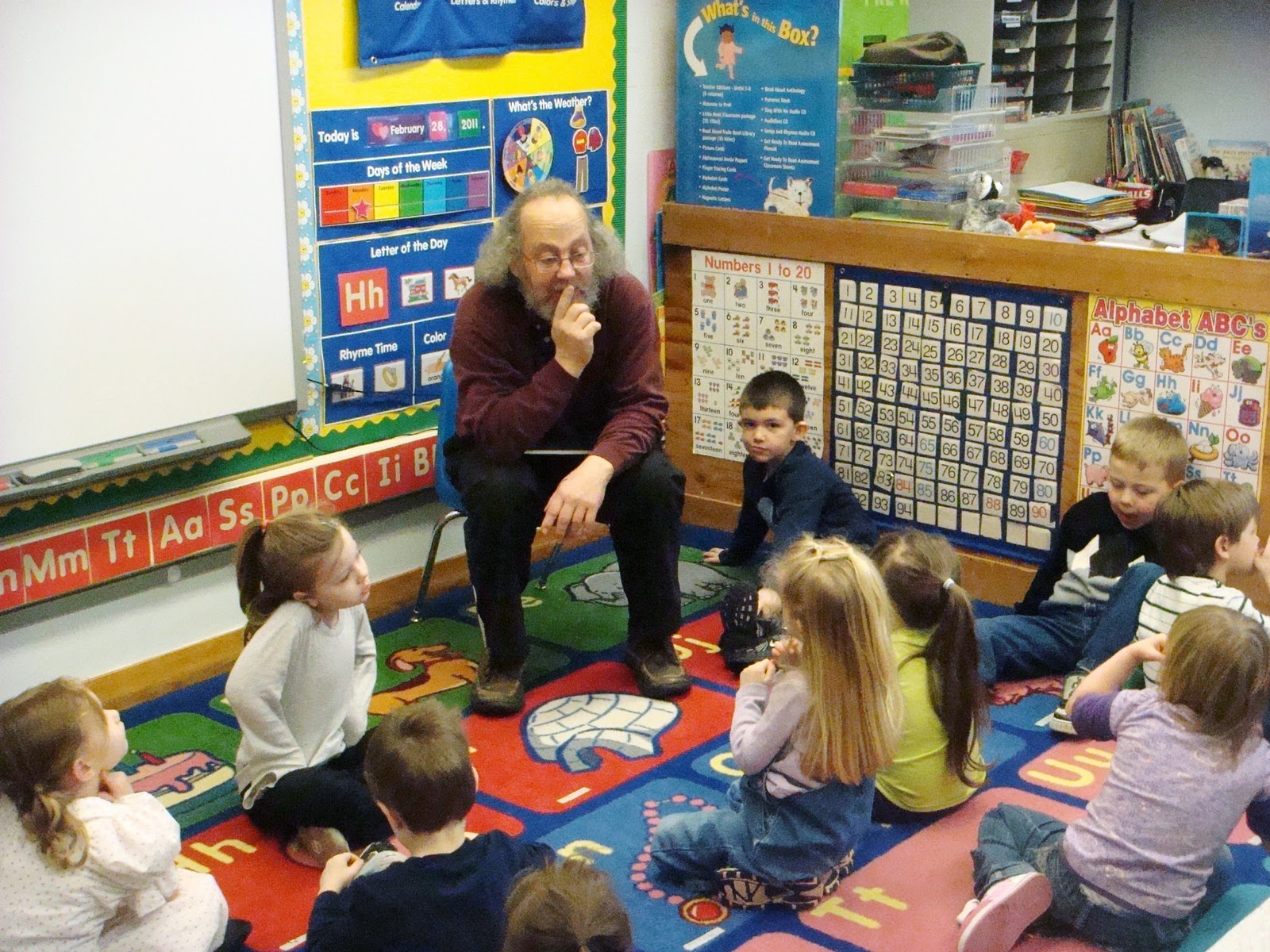
Michael Czarnecki works with Frank Pierce Early Childhood students
It is hard to believe that another year has flown by, but Arts in Education at its best is taking place once again at Frank Pierce Early Childhood Center. Students are four sessions into their poet-in-residence program with poet, Mr. Michael Czarnecki, who has been working with all classes at FP. Each of the classes collectively produce a poem which will be put into a published poetry book. They will celebrate the poetry on March 25th with a Poetry Share.
Once the poetry sessions end they will have Mr. Joe Crookston, songwriter, in residence here to turn the poetry into song. The pictures below were taken this year, but click on the links at the bottom of the post to get an idea how the whole program works.


Pajama Day!



http://www.gstboces.org/iss/artsineducation/FrankPierceCorning/2010-02-24-1353-46/michael_czarnecki.htm
http://www.gstboces.org/iss/artsineducation/FrankPierceCorning/Joe%20Crookston/JoeCrookston.htm
Thursday, January 27, 2011
John Maeda - Arts Education to make "STEM" "STEAM"
The following link to "The Guardian" will take you to yet another compelling argument for integrating the arts into the academic curriculum.
http://www.guardian.co.uk/technology/2010/nov/14/my-bright-idea-john-maeda
It is Maeda's conviction that scientists need art and artists in their professional lives in order to invent and innovate successfully, and with a particular focus on education he has toured the world to promote the idea that government-approved "Stem" subjects (science, technology, engineering and maths) should be widened to include art; "turning Stem into Steam," as he puts it. This week Maeda, who is president of the Rhode Island School of Design, will expound on these ideas at an experimental installation at London's Riflemaker gallery, where he will "dispense wisdom from a sandpit".
http://www.guardian.co.uk/technology/2010/nov/14/my-bright-idea-john-maeda
It is Maeda's conviction that scientists need art and artists in their professional lives in order to invent and innovate successfully, and with a particular focus on education he has toured the world to promote the idea that government-approved "Stem" subjects (science, technology, engineering and maths) should be widened to include art; "turning Stem into Steam," as he puts it. This week Maeda, who is president of the Rhode Island School of Design, will expound on these ideas at an experimental installation at London's Riflemaker gallery, where he will "dispense wisdom from a sandpit".
Wednesday, December 8, 2010
Sara Holbrook presents poetry at Parley Coburn Elementary School!
I can entertain kids. No problem. Give me your bored, your skeptical and your reluctant and I can entertain them. But an author visit is not just a live animation puppet show; it should be a learning experience. I've been at this for 16 years and have (through some hard knocks) developed a do's and (please please) don'ts list of guidelines to make a visit as beneficial and pain free as possible.
Sara Holbrook
Pictured below is the performance poet, Sara Holbrook, at work in the classroom at Parley Coburn Elementary School. Sara provides standards based writing across the curriculum and improves oral presentation skills and reading fluency with poetry performance. She has been writing for most of her life and shared her passion and her skills with the fortunate students here in the GST BOCES region.
To learn more about Sara, check out her web-page http://www.saraholbrook.com/ and blog, http://saraholbrook.blogspot.com/


Tuesday, November 23, 2010
Mae Jemison, astronaut, medical doctor, engineer, dancer and art collector on the reconcilliation of science and the arts
Dr. Mae Jemison (medical doctor and engineer) is a great achiever in multiple disciplines, but she is most renowned for her explorations in outerspace! What many do not know about her, however, is that she also dances and is an avid collector of art. In fact, Dr. Jemison believes that the best, most comprehensive education is one that combines science and the arts.
I think our mission is to reconcile and reintegrate science and the arts because right now there is a schism that exists in popular culture...but it's really becoming critical now...to see that scientists can be creative and artists can be analytical. The creativity we were required to have to conceive and build and launch the space shuttle springs from the same sources of imagination and analysis it took to carve a bundu statue or the ingenuity it took to design, choreograph and stage "Cry." http://www.youtube.com/watch?v=Ynf2IHiFqV0&feature=related Each one of them are different manifestations, incarnations of creativity.
Dr. Jemison was a featured speaker on the renowned series, TED talks. To hear her compelling argument for arts integration in education, click on the following link.
http://www.ted.com/talks/mae_jemison_on_teaching_arts_and_sciences_together.html
I think our mission is to reconcile and reintegrate science and the arts because right now there is a schism that exists in popular culture...but it's really becoming critical now...to see that scientists can be creative and artists can be analytical. The creativity we were required to have to conceive and build and launch the space shuttle springs from the same sources of imagination and analysis it took to carve a bundu statue or the ingenuity it took to design, choreograph and stage "Cry." http://www.youtube.com/watch?v=Ynf2IHiFqV0&feature=related Each one of them are different manifestations, incarnations of creativity.
Dr. Jemison was a featured speaker on the renowned series, TED talks. To hear her compelling argument for arts integration in education, click on the following link.
http://www.ted.com/talks/mae_jemison_on_teaching_arts_and_sciences_together.html
Wednesday, November 3, 2010
"We're educating people out of their creative capacities"
Sir Ken Robinson believes that our educational system should be radically changed. He is an advocate for arts in education and subscribes to the theory of multiple intelligences. He has written many books and articles and was a professor at the University of Warwick and Director of the Arts in Schools Project. He was knighted in 2003.
http://www.ted.com/talks/ken_robinson_says_schools_kill_creativity.html
http://www.ted.com/talks/ken_robinson_says_schools_kill_creativity.html
My contention is that creativity is now as important in education as literacy and we should treat it with the same status.
Kids will take a chance. If they don't know, they'll have a go....They're not frightened of being wrong. Now I don't mean to say that being wrong is the same thing as being creative. What we do know is if you're not prepared to be wrong, you'll never come up with anything original....And by the time they are adults, most kids have lost that capacity. They have become frightened of being wrong. And we run our companies...we stigmatize mistakes and we are now running national education systems where mistakes are the worst thing you can make and the result is that we're educating people out of their creative capacities.
Many highly talented, BRILLIANT, creative people think they're not, because everything they're good at in school wasn't valued or was actually stigmatized.
We need to radically rethink our view of intelligence. We know three things about intelligence 1) It's diverse - we think visually, we think in sound, we think kinesthetically, we think in abstract terms, we think in movement. Secondly, intelligence is dynamic 3) It's distinct.
I believe our only hope for the future is to adopt a new conception of human ecology - one in which we start to reconstitute our conception of the richness of human capacity. Our education system has mined our minds in the way we have strip-mined the earth - for a particular commodity.
Kids will take a chance. If they don't know, they'll have a go....They're not frightened of being wrong. Now I don't mean to say that being wrong is the same thing as being creative. What we do know is if you're not prepared to be wrong, you'll never come up with anything original....And by the time they are adults, most kids have lost that capacity. They have become frightened of being wrong. And we run our companies...we stigmatize mistakes and we are now running national education systems where mistakes are the worst thing you can make and the result is that we're educating people out of their creative capacities.
Many highly talented, BRILLIANT, creative people think they're not, because everything they're good at in school wasn't valued or was actually stigmatized.
We need to radically rethink our view of intelligence. We know three things about intelligence 1) It's diverse - we think visually, we think in sound, we think kinesthetically, we think in abstract terms, we think in movement. Secondly, intelligence is dynamic 3) It's distinct.
I believe our only hope for the future is to adopt a new conception of human ecology - one in which we start to reconstitute our conception of the richness of human capacity. Our education system has mined our minds in the way we have strip-mined the earth - for a particular commodity.
Wednesday, September 29, 2010
Education and the "Conceptual Age:" the thinking of Daniel Pink
If you are an educator and you are not yet familiar with the thinking and writing of Daniel Pink, here are some links to serve as an introduction. Pink is the author of four books including A Whole New Mind; Free Agent Nation; The Adventures of Johnny Bunko, and Drive: The Surprising Truth About What Motivates Us. He has written articles for The New York Times, Harvard Business Review, Fast Company and Wired.
Pink's insights have major relevance for all areas of the academic and arts curricula. According to Pink, "the Information Age" is now giving way to "the Conceptual Age" and this has implications not only for the corporate world, but for pedagogy.
It used to be the abilities that matter most in work were characteristic of the 'left hemisphere.' They were the logical, linear, sequential, analytical SAT spreadsheet - dare I say 'no child left behind' - kind of abilities. Those kinds of abilities are absolutely necessary - 100% necessary - but they are no longer sufficient. Right brain abilitites - abilities having to do with artistry, empathy, inventiveness, big picture thinking - these are now the abilities that matter most...in nearly every profession and a whole range of industries.... These metaphorically right brain abilitites are becoming the first among equals; they are becoming basically the engines of the economy....
http://www.wired.com/wired/archive/13.02/brain.html (Revenge of the Right Brain, Wired)
Related to this argument is Pink's investigation of motivation. Linked below is a Ted talk entitled "Dan Pink on the surprising science of motivation" filmed July, 20009.
http://www.ted.com/talks/dan_pink_on_motivation.html
If we really want to get out of this economic mess - if we really want high performance on those definitional tasks of the 21st century - the solution is not to do more of the wrong things - to entice people with a sweeter carrot or threaten them with a sharper stick. We need a whole new approach. The good news is that the scientists who have been studying motivation have given us this new approach. It's an approach built much more around intrinsic motivation - around the desire to do things because they matter, because we like it, because they're interesting, because they're part of something important. Management is great if you want compliance, but if you want engagement, self-direction works better.
He cites the examples of Microsoft's encyclopedia "Encarta" vs. "Wikipedia."
Microsoft started a new encyclopedia called Encarta. They deployed the right incentives. They paid professionals to write and edit thousands of articles. Well compensated managers oversaw the whole thing to make sure everything came in on budget and on time.
A few years later, another encyclopedia got started. Different model: do it for fun, no one gets paid a cent or a euro or yen, do it because you like to do it.
Now if you had gone to an economist and said, "Hey, I've got these two different models for creating an encyclopedia! If they went head to head, who would win? Ten years ago, you could not have found a single, sober economist anywhere on planet earth who would have predicted the Wikipedia model.
According to Pink
This is the Ali-Frasier of motivation. Instrinsic motivators vs. extrinsic motivators. Autonomy, mastery and purpose vs. carrots and sticks. And who wins? Autonomy, Mastery and Purpose in a knockout!
The implications of Pink's thinking on the arts curriculum are obvious and myriad. In fact, Pink cites the fact that many corporations are catching onto the skills artists can bring to the workplace.
Corporate recruiters have begun visiting the top arts grad schools...in search of talent....With applications climbing and ever more arts grads occupying key corporate positions, the master of fine arts is becoming the new business degree.
Administrators and teachers who are privy to current trends in the economic sector can no longer afford to relegate arts instruction to the periphery of the curriculum.
http://www.drawingonthepromises.com/blogs/blank/2005/03/mfa-is-new-mba.html
http://www.danpink.com/
Pink's insights have major relevance for all areas of the academic and arts curricula. According to Pink, "the Information Age" is now giving way to "the Conceptual Age" and this has implications not only for the corporate world, but for pedagogy.
It used to be the abilities that matter most in work were characteristic of the 'left hemisphere.' They were the logical, linear, sequential, analytical SAT spreadsheet - dare I say 'no child left behind' - kind of abilities. Those kinds of abilities are absolutely necessary - 100% necessary - but they are no longer sufficient. Right brain abilitites - abilities having to do with artistry, empathy, inventiveness, big picture thinking - these are now the abilities that matter most...in nearly every profession and a whole range of industries.... These metaphorically right brain abilitites are becoming the first among equals; they are becoming basically the engines of the economy....
http://www.wired.com/wired/archive/13.02/brain.html (Revenge of the Right Brain, Wired)
Related to this argument is Pink's investigation of motivation. Linked below is a Ted talk entitled "Dan Pink on the surprising science of motivation" filmed July, 20009.
http://www.ted.com/talks/dan_pink_on_motivation.html
If we really want to get out of this economic mess - if we really want high performance on those definitional tasks of the 21st century - the solution is not to do more of the wrong things - to entice people with a sweeter carrot or threaten them with a sharper stick. We need a whole new approach. The good news is that the scientists who have been studying motivation have given us this new approach. It's an approach built much more around intrinsic motivation - around the desire to do things because they matter, because we like it, because they're interesting, because they're part of something important. Management is great if you want compliance, but if you want engagement, self-direction works better.
He cites the examples of Microsoft's encyclopedia "Encarta" vs. "Wikipedia."
Microsoft started a new encyclopedia called Encarta. They deployed the right incentives. They paid professionals to write and edit thousands of articles. Well compensated managers oversaw the whole thing to make sure everything came in on budget and on time.
A few years later, another encyclopedia got started. Different model: do it for fun, no one gets paid a cent or a euro or yen, do it because you like to do it.
Now if you had gone to an economist and said, "Hey, I've got these two different models for creating an encyclopedia! If they went head to head, who would win? Ten years ago, you could not have found a single, sober economist anywhere on planet earth who would have predicted the Wikipedia model.
According to Pink
This is the Ali-Frasier of motivation. Instrinsic motivators vs. extrinsic motivators. Autonomy, mastery and purpose vs. carrots and sticks. And who wins? Autonomy, Mastery and Purpose in a knockout!
The implications of Pink's thinking on the arts curriculum are obvious and myriad. In fact, Pink cites the fact that many corporations are catching onto the skills artists can bring to the workplace.
Corporate recruiters have begun visiting the top arts grad schools...in search of talent....With applications climbing and ever more arts grads occupying key corporate positions, the master of fine arts is becoming the new business degree.
Administrators and teachers who are privy to current trends in the economic sector can no longer afford to relegate arts instruction to the periphery of the curriculum.
http://www.drawingonthepromises.com/blogs/blank/2005/03/mfa-is-new-mba.html
http://www.danpink.com/
"The Maestro" and the Marching Band
Dr. William P. Foster, who also became known as "The Maestro," was an extraordinary and innovative human being. Foster, who died at the age of 91 in August, 2010, had faced racial barriers all his life. One of these obstacles prohibited him from fulfilling his original dream of becoming a conductor. This impediment only motivated Foster to one day lead an all black marching band that would surpass all other bands.
According to Richard Goldstein, writer of Foster's obituary for the New York Times
http://www.nytimes.com/2010/08/30/sports/football/30foster.html
Dr. Foster introduced shows that infused black popular culture into his routines, blending contemporary music, often jazz or rock, with imaginative choreography, his green-and-orange uniformed band members carrying their instruments at a 45-degree angle, legs bent to the same angle.
Below is a video featuring the unprecedented famous Marching 100 Band of Florida A&M University
http://www.famu.edu/index.cfm?a=marching100
According to Richard Goldstein, writer of Foster's obituary for the New York Times
http://www.nytimes.com/2010/08/30/sports/football/30foster.html
Dr. Foster introduced shows that infused black popular culture into his routines, blending contemporary music, often jazz or rock, with imaginative choreography, his green-and-orange uniformed band members carrying their instruments at a 45-degree angle, legs bent to the same angle.
Below is a video featuring the unprecedented famous Marching 100 Band of Florida A&M University
http://www.famu.edu/index.cfm?a=marching100
Thursday, March 25, 2010
Teaching Science and Technology through Media Arts and the Arts
A fascinating panel discussion called The Effect of Electronics on Art took place at the State of the Art Gallery in Ithaca, NY recently during which three regional artists delineated some of the ways technology has revolutionized the way they, and many other artists, make art. Of course, the way art is made has vast implications for the way art is or will be taught in our schools. Artists/panelists included John Criscitello from Ithaca, NY; GST BOCES Arts in Education artist, Rhonda Morton from Corning; and Tammy Renée Brackett of Alfred, NY.
For each one of these singular artists, technology - be it a computer, a camera or a telephone - is considered to be a tool for creating, promoting and/or disseminating art. It is a tool just as paint and pencils are tools. For each of these artists, the content and the artistic merit of the piece comes first; in some instances, however, it is difficult to separate the tool from the content as the insinuation of technology in every aspect of our lives has a myriad of socio-political implications in and of itself.
Tammy Renée Brackett
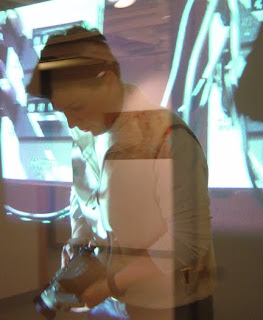
I push a lot of buttons. Tammy Renée Brackett
Tammy Renée Brackett is a professor of digital media and animation at Alfred State College. She has exhibited in Japan, Croatia, Hungary, China and the United States and was included in the Albright-Knox Art Gallery’s biennial exhibition, Beyond/In Western New York in 2005 and 2007.
Of the three artists who appeared with the panel, Tammy is arguably the “most” technological. Brackett likes to combine old technology with new technology as she frequently strives to leave the viewer with a “question of apocalyptic possibility.” Disturbing revelation is especially pronounced in works such as Spider Goat, about which Tammy writes "Science’s pets very often become culture’s monsters..." Spider Goat was inspired by a real product called BioSteel, which is genetically engineered material made from spider silk (purported to be the “world’s strongest material”) produced in goat’s milk for the purpose of producing “bulletproof body armor, surgical suture material, and biodegradable fishing line” among other things.
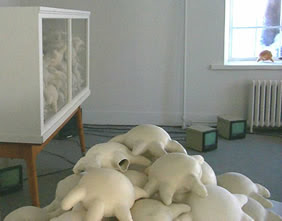
Spider Goat, video, sculpture, drawing, and materials derived from laboratory experiments utilizing the artist's own genomic DNA, December, 2003
Tammy's educational background includes an MFA in Electronic Integrated Art from the School of Art and Design at Alfred University. Because she is so learned, it may seem surprising to learn that Tammy does not also have a background in molecular biology or genetic engineering. Rather, she learns a lot from her own research and from her associations with friends who are scientists. Sometimes she is given things, such as a hospital’s cast-off bio-feedback machine which Brackett uses extensively in her interactive work.
While the viewer can surely learn a lot about science through Brackett’s work, it is not Tammy’s intention to merely inform, but to critique science and the spin it is given through mass media. As the artist herself states, her work “explores the blurry ethics of a frenetic acceleration in acquisition of scientific knowledge.”
Tammy is also really intrigued with identity formation and the way identity is also manipulated by science and mass media. How do “new” scientific discoveries alter our self-perceptions or our perceptions of others? As for John Criscitello, audio is as important as video in her work.
In Opus Musivum, for instance, Brackett made a musical score (including her own voice) combined with bio-feedback from the first publication of the map of the human genome. The map, according to Brackett, resembled sheet music. In other works, the x chromosome as well as the "gay gene," are the basis for interactive art.
While John Criscitello declares that “content is more important than the technology” in his work, it would be difficult to sort out the content from the technology in Brackett’s work. She uses plasma screen, video cameras, computers, specialized software, four channel surround sound and a bio-feedback machine to create an immersive futuristic-seeming world enabling the viewer to better experience – and believe – its dystopian potential. It is science and technology referencing and critiquing itself. Tammy’s work hauntingly and powerfully comments on a thing through its very use.
http://www.whitedogrecords.com/TRB.htm
John Criscitello
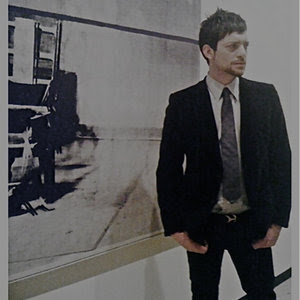
Video is a 21st century application of art. It is still in its infancy, however. We are still in 'caveman days' when it comes to digital media. John Criscitello
Multi-media and installation artist and painter, John Criscitello, has worked as an artist for the past twenty years. He is also the director of a non profit Contemporary Art Space in Ithaca and founded the quarterly screening of video and short film called Video/Art/Ithaca. His videos have been screened regionally and internationally in places including NYC, Michigan, Italy and Brazil.
John uses technology in a myriad of ways. His work ranges from works on paper created with traditional media to video art to complex installations incorporating projections and various digital media. In each case, John has taught himself these techniques. For John, content is always preeminent over technology. His work comments on mass media, consumer culture, youth culture, violence, celebrity, etc.
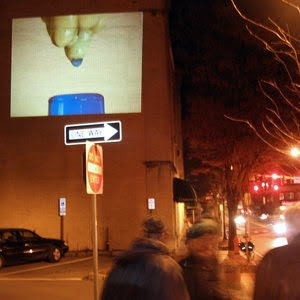
He reveals "punk rock roots" and an "ethic of doing with nothing" that has carried him from a working class childhood through to adulthood. He likes to share what he does; thus, he organizes shows and events usually without benefit of funding. Some of these events take place in his own studio in Ithaca and other times, "exterior projections" illuminate the sides of buildings in Ithaca such as the Community School of Arts and the Masonic Temple at night as shown in the photograph below.
John started out as a sculptor and a painter, having won the John H. Loy Honers Award in Painting. He began experimenting with video in 1992 during an artist's residency in Utica, NY. and has been doing it - as well as painting and drawing - ever since.
For John, video is frequently more engaging for the viewer than painting; it is a time-based medium and this provides a "hook" for viewers who always want to "see what's next."
John indicates that he has always been an artist who works more with objects than people; he enjoys the surprises that sometimes occur in the combination of various - sometimes incongruous - objects.
He also likes to challenge people's notions, not only of what constitutes art, but reality. He likes to "puncture" the "post-Warholian" world of image, surface and celebrity and call it into question. “This sometimes makes people upset,” says John, but clearly not enough to deter him from his objective.
John quips that he is a member of the first tv generation of “short cuts and short attention spans.” This is reflected in the "kinetic collage" quality of his work. To achieve this effect, John films his own footage in addition to mining the creative commons for both video and sound. (He frequently uses "Free Sound," as sources for audio.) John cites the JAWA Manifesto as inspiration for this approach. http://www.tasmanrichardson.com/Jawa_manifesto_2008.pdf
As with Tammy Renee Brackett, John's work frequently uses technology in a self-referential way; he uses technology and popular culture in order to critique it; thus, his work is a lesson, not only in the use of technology, but in media literacy. Most of all, it is, as Criscitello expresses it, "a continuing exploration of spirituality in a world of loss."
To read more about John’s views on video art and arts in education, see “A Conversation with John Criscitello” from a previous visit below.
http://www.vimeo.com/jcrisci
Rhonda Morton
The Technology I use is very basic. Rhonda Morton
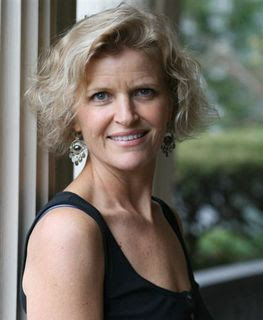
A GST BOCES artist, Rhonda Morton, founder and creator of Alligator Mouth Five, GirlSmarts and Performance Deli (among other endeavors) described herself as the “least technological” of the three artists, emphasizing that the most important and powerful aspects of her art remain in the human connection and “in person” performances which can consist of any combination of improvisational dance, music, song, poetry and video projections. However, what the viewer may not realize as they watch Rhonda perform - sometimes as a solo act, and sometimes with several other dancers and musicians - is that she “uses technology from start to finish” in promotion, sharing and connection with viewers and other artists. She described her equipment as being “very basic” – a computer, video camera and phone.
She described her process and its various aspects as follows:
1) She always video-tapes rehearsals, starting with raw footage, which she then gives it to a professional for editing.
2) She uses the internet and video for art promotion, sharing and connection. Her web-site is very “video intensive,” and she makes ample use of “You-Tube” and social networking sites.
3) For “Performance Deli,” Rhonda and members from her troupe, “Alligator Mouth Five,” set up in front of a store. People made on-line “orders” for the dancers to improvise. These improvisations were then posted on ‘You Tube.”
4) Rhonda and her crew recorded people staring silently at the camera for long periods of time. The photographs were then pieced together and projected onto a very large screen during performances as she and the dancers sang a blessing to the faces in a black theatre. Because of the success of this aspect of the performance, Rhonda and her dancers now take a moment to gaze silently into the audience before beginning their performances. This is called “inviting to be seen.”
5) They use a looper whereby a musician plays to recorded music.
6) They are now using an on-line application called “Kickstarter” to build on their web-site. People use “Kickstarter” to write books…and engage in “change the world projects.” It is a way to educate and connect with people.
7) Rhonda is getting certified in FEBE on-line – FEBE is an acronym that stands for Focused Energy Balance Indicator.
10) Rhonda can connect with people from all over the world through the internet and the telephone.
Thus, Rhonda’s art is a rich, multi-layered combination of improvisational theatre, dance, song, music, and digital media. Viewers can expect to experience a full range of emotions as Rhonda and her troupe - ever willing to risk vulnerability - deliver drama and comedy (sometimes even a touch of slapstick) for their audience. While technology may not seem to substantially influence the content of Rhonda's art, it surely opens up possibilities for locations, dissemination, promotion and connection. It enables Rhonda to reach many more people than she might otherwise have done so. Her work is dynamic and always evolving, treating her audiences to something new every time they participate or view a performance. To learn more about Rhonda Morton and her work in schools, see other posts on this blog http://gstbocesartsineducation.blogspot.com/2009/10/meet-cast-of-move-it-in-this-premiere.html, as well as the following links.
http://www.rhondamorton.com/
http://www.alligatormouth.com/
http://www.alligatormouth.com/bites,
http://www.youtube.com/watch?v=ZqXQsnwurwU .
A Conversation with John Criscitello
Art is no longer a race towards realism. John Criscitello
I met with John Criscitello at his Sfumato Studio in Ithaca a few months ago to talk about art education in the 21st century. While John has not taught in public schools, his work, in both content and technique, confronts a frequently raw and disturbing world that is most relevant to life and youth culture in contemporary society. He uses both traditional and digital media in his work.
Video is a leveling thing - you don't need color theory, realistic drawing technique or drafting. In the past, if a kid couldn't draw realistically - let's say an apple - he or she would just give up. Kids are technically savvier now than in previous generations, and video is just another tool for art. Kids who can't paint or draw, flip into photography. All kids have cameras and Photoshop editing capabilities. Art is no longer a 'race towards realism.'"
The technological explosion has rendered students comfortable behind and in front of the camera lens. The thing of which kids are deprived according to John, is a cultural and artistic awareness that their European counterparts possess.
American students know how to use the tools of an artist, but they still do not understand what it is the artist does; they do not understand the art! In Europe, people know how to appreciate, look at and speak about art. I feel sorry for kids in this country...all children should have the opportunity to learn about the history of art and to learn how to speak about it, but the ability to talk about art is a learned skill. I am an advocate for young people; art is important for them. It is not superfluous.
John feels that American youth is losing out as they are deprived of experiences and the essential education to cultivate this aptitude. He deals with people of all ages, but has discovered that most kids - and many adults - do not even know who Andy Warhol is. "We live in Warhol's world and we aren't aware of it."
Indeed, with You Tube and a plethora of reality shows, virtually anybody can now experience Warhol's fifteen minutes of fame. We are all, it seems, (or worse, it DOESN'T seem) stuck within the simulacrum.
Although John laments the insufficient arts education and exposure the majority of Americans are given, he does note that some things are much easier than they used to be. With technology, everything is becoming decentralized and artists are able to produce and promote work.
They no longer have to work through an archaic system of school, professorship and gallery hunting. While most video artists live in Europe - there is much more opportunity today for American artists. In the old days, artists were sequestered. Today, artists can make close connections to other artists from all over the world in an international community through the internet and other technology.
Artists can become teachers, facilitators in a form of communication that may, as a matter of fact, have no monetary value at all. This does not mean, however, that is has no value. Quite to the contrary! Many young people feel misunderstood and are in need of a means for expression. For young people who are troubled or at risk of suicide, art can be a way to see them through (art as therapy).
While the arts are vital to the education of children for all they teach us about multiple aspects of the academic curriculum, culture and the human condition, John does not dismiss one of the oldest and most widely recognized powers of art - the power of art to heal.
For each one of these singular artists, technology - be it a computer, a camera or a telephone - is considered to be a tool for creating, promoting and/or disseminating art. It is a tool just as paint and pencils are tools. For each of these artists, the content and the artistic merit of the piece comes first; in some instances, however, it is difficult to separate the tool from the content as the insinuation of technology in every aspect of our lives has a myriad of socio-political implications in and of itself.
Tammy Renée Brackett

I push a lot of buttons. Tammy Renée Brackett
Tammy Renée Brackett is a professor of digital media and animation at Alfred State College. She has exhibited in Japan, Croatia, Hungary, China and the United States and was included in the Albright-Knox Art Gallery’s biennial exhibition, Beyond/In Western New York in 2005 and 2007.
Of the three artists who appeared with the panel, Tammy is arguably the “most” technological. Brackett likes to combine old technology with new technology as she frequently strives to leave the viewer with a “question of apocalyptic possibility.” Disturbing revelation is especially pronounced in works such as Spider Goat, about which Tammy writes "Science’s pets very often become culture’s monsters..." Spider Goat was inspired by a real product called BioSteel, which is genetically engineered material made from spider silk (purported to be the “world’s strongest material”) produced in goat’s milk for the purpose of producing “bulletproof body armor, surgical suture material, and biodegradable fishing line” among other things.

Spider Goat, video, sculpture, drawing, and materials derived from laboratory experiments utilizing the artist's own genomic DNA, December, 2003
Tammy's educational background includes an MFA in Electronic Integrated Art from the School of Art and Design at Alfred University. Because she is so learned, it may seem surprising to learn that Tammy does not also have a background in molecular biology or genetic engineering. Rather, she learns a lot from her own research and from her associations with friends who are scientists. Sometimes she is given things, such as a hospital’s cast-off bio-feedback machine which Brackett uses extensively in her interactive work.
While the viewer can surely learn a lot about science through Brackett’s work, it is not Tammy’s intention to merely inform, but to critique science and the spin it is given through mass media. As the artist herself states, her work “explores the blurry ethics of a frenetic acceleration in acquisition of scientific knowledge.”
Tammy is also really intrigued with identity formation and the way identity is also manipulated by science and mass media. How do “new” scientific discoveries alter our self-perceptions or our perceptions of others? As for John Criscitello, audio is as important as video in her work.
In Opus Musivum, for instance, Brackett made a musical score (including her own voice) combined with bio-feedback from the first publication of the map of the human genome. The map, according to Brackett, resembled sheet music. In other works, the x chromosome as well as the "gay gene," are the basis for interactive art.
While John Criscitello declares that “content is more important than the technology” in his work, it would be difficult to sort out the content from the technology in Brackett’s work. She uses plasma screen, video cameras, computers, specialized software, four channel surround sound and a bio-feedback machine to create an immersive futuristic-seeming world enabling the viewer to better experience – and believe – its dystopian potential. It is science and technology referencing and critiquing itself. Tammy’s work hauntingly and powerfully comments on a thing through its very use.
http://www.whitedogrecords.com/TRB.htm
John Criscitello

Video is a 21st century application of art. It is still in its infancy, however. We are still in 'caveman days' when it comes to digital media. John Criscitello
Multi-media and installation artist and painter, John Criscitello, has worked as an artist for the past twenty years. He is also the director of a non profit Contemporary Art Space in Ithaca and founded the quarterly screening of video and short film called Video/Art/Ithaca. His videos have been screened regionally and internationally in places including NYC, Michigan, Italy and Brazil.
John uses technology in a myriad of ways. His work ranges from works on paper created with traditional media to video art to complex installations incorporating projections and various digital media. In each case, John has taught himself these techniques. For John, content is always preeminent over technology. His work comments on mass media, consumer culture, youth culture, violence, celebrity, etc.
He reveals "punk rock roots" and an "ethic of doing with nothing" that has carried him from a working class childhood through to adulthood. He likes to share what he does; thus, he organizes shows and events usually without benefit of funding. Some of these events take place in his own studio in Ithaca and other times, "exterior projections" illuminate the sides of buildings in Ithaca such as the Community School of Arts and the Masonic Temple at night as shown in the photograph below.

John started out as a sculptor and a painter, having won the John H. Loy Honers Award in Painting. He began experimenting with video in 1992 during an artist's residency in Utica, NY. and has been doing it - as well as painting and drawing - ever since.
For John, video is frequently more engaging for the viewer than painting; it is a time-based medium and this provides a "hook" for viewers who always want to "see what's next."
John indicates that he has always been an artist who works more with objects than people; he enjoys the surprises that sometimes occur in the combination of various - sometimes incongruous - objects.
He also likes to challenge people's notions, not only of what constitutes art, but reality. He likes to "puncture" the "post-Warholian" world of image, surface and celebrity and call it into question. “This sometimes makes people upset,” says John, but clearly not enough to deter him from his objective.
John quips that he is a member of the first tv generation of “short cuts and short attention spans.” This is reflected in the "kinetic collage" quality of his work. To achieve this effect, John films his own footage in addition to mining the creative commons for both video and sound. (He frequently uses "Free Sound," as sources for audio.) John cites the JAWA Manifesto as inspiration for this approach. http://www.tasmanrichardson.com/Jawa_manifesto_2008.pdf
As with Tammy Renee Brackett, John's work frequently uses technology in a self-referential way; he uses technology and popular culture in order to critique it; thus, his work is a lesson, not only in the use of technology, but in media literacy. Most of all, it is, as Criscitello expresses it, "a continuing exploration of spirituality in a world of loss."
To read more about John’s views on video art and arts in education, see “A Conversation with John Criscitello” from a previous visit below.
http://www.vimeo.com/jcrisci
Rhonda Morton

The Technology I use is very basic. Rhonda Morton
A GST BOCES artist, Rhonda Morton, founder and creator of Alligator Mouth Five, GirlSmarts and Performance Deli (among other endeavors) described herself as the “least technological” of the three artists, emphasizing that the most important and powerful aspects of her art remain in the human connection and “in person” performances which can consist of any combination of improvisational dance, music, song, poetry and video projections. However, what the viewer may not realize as they watch Rhonda perform - sometimes as a solo act, and sometimes with several other dancers and musicians - is that she “uses technology from start to finish” in promotion, sharing and connection with viewers and other artists. She described her equipment as being “very basic” – a computer, video camera and phone.
She described her process and its various aspects as follows:
1) She always video-tapes rehearsals, starting with raw footage, which she then gives it to a professional for editing.
2) She uses the internet and video for art promotion, sharing and connection. Her web-site is very “video intensive,” and she makes ample use of “You-Tube” and social networking sites.
3) For “Performance Deli,” Rhonda and members from her troupe, “Alligator Mouth Five,” set up in front of a store. People made on-line “orders” for the dancers to improvise. These improvisations were then posted on ‘You Tube.”
4) Rhonda and her crew recorded people staring silently at the camera for long periods of time. The photographs were then pieced together and projected onto a very large screen during performances as she and the dancers sang a blessing to the faces in a black theatre. Because of the success of this aspect of the performance, Rhonda and her dancers now take a moment to gaze silently into the audience before beginning their performances. This is called “inviting to be seen.”
5) They use a looper whereby a musician plays to recorded music.
6) They are now using an on-line application called “Kickstarter” to build on their web-site. People use “Kickstarter” to write books…and engage in “change the world projects.” It is a way to educate and connect with people.
7) Rhonda is getting certified in FEBE on-line – FEBE is an acronym that stands for Focused Energy Balance Indicator.
10) Rhonda can connect with people from all over the world through the internet and the telephone.
Thus, Rhonda’s art is a rich, multi-layered combination of improvisational theatre, dance, song, music, and digital media. Viewers can expect to experience a full range of emotions as Rhonda and her troupe - ever willing to risk vulnerability - deliver drama and comedy (sometimes even a touch of slapstick) for their audience. While technology may not seem to substantially influence the content of Rhonda's art, it surely opens up possibilities for locations, dissemination, promotion and connection. It enables Rhonda to reach many more people than she might otherwise have done so. Her work is dynamic and always evolving, treating her audiences to something new every time they participate or view a performance. To learn more about Rhonda Morton and her work in schools, see other posts on this blog http://gstbocesartsineducation.blogspot.com/2009/10/meet-cast-of-move-it-in-this-premiere.html, as well as the following links.
http://www.rhondamorton.com/
http://www.alligatormouth.com/
http://www.alligatormouth.com/bites,
http://www.youtube.com/watch?v=ZqXQsnwurwU .
A Conversation with John Criscitello
Art is no longer a race towards realism. John Criscitello
I met with John Criscitello at his Sfumato Studio in Ithaca a few months ago to talk about art education in the 21st century. While John has not taught in public schools, his work, in both content and technique, confronts a frequently raw and disturbing world that is most relevant to life and youth culture in contemporary society. He uses both traditional and digital media in his work.
Video is a leveling thing - you don't need color theory, realistic drawing technique or drafting. In the past, if a kid couldn't draw realistically - let's say an apple - he or she would just give up. Kids are technically savvier now than in previous generations, and video is just another tool for art. Kids who can't paint or draw, flip into photography. All kids have cameras and Photoshop editing capabilities. Art is no longer a 'race towards realism.'"
The technological explosion has rendered students comfortable behind and in front of the camera lens. The thing of which kids are deprived according to John, is a cultural and artistic awareness that their European counterparts possess.
American students know how to use the tools of an artist, but they still do not understand what it is the artist does; they do not understand the art! In Europe, people know how to appreciate, look at and speak about art. I feel sorry for kids in this country...all children should have the opportunity to learn about the history of art and to learn how to speak about it, but the ability to talk about art is a learned skill. I am an advocate for young people; art is important for them. It is not superfluous.
John feels that American youth is losing out as they are deprived of experiences and the essential education to cultivate this aptitude. He deals with people of all ages, but has discovered that most kids - and many adults - do not even know who Andy Warhol is. "We live in Warhol's world and we aren't aware of it."
Indeed, with You Tube and a plethora of reality shows, virtually anybody can now experience Warhol's fifteen minutes of fame. We are all, it seems, (or worse, it DOESN'T seem) stuck within the simulacrum.
Although John laments the insufficient arts education and exposure the majority of Americans are given, he does note that some things are much easier than they used to be. With technology, everything is becoming decentralized and artists are able to produce and promote work.
They no longer have to work through an archaic system of school, professorship and gallery hunting. While most video artists live in Europe - there is much more opportunity today for American artists. In the old days, artists were sequestered. Today, artists can make close connections to other artists from all over the world in an international community through the internet and other technology.
Artists can become teachers, facilitators in a form of communication that may, as a matter of fact, have no monetary value at all. This does not mean, however, that is has no value. Quite to the contrary! Many young people feel misunderstood and are in need of a means for expression. For young people who are troubled or at risk of suicide, art can be a way to see them through (art as therapy).
While the arts are vital to the education of children for all they teach us about multiple aspects of the academic curriculum, culture and the human condition, John does not dismiss one of the oldest and most widely recognized powers of art - the power of art to heal.
Wednesday, March 17, 2010
Tedd Arnold, renowned children's book author and illustrator and GST BOCES directory artist, appears at the Arnot Art Museum
 The Mayor of Elmira, the honorable John S. Tonello, presents renowned children's book author and illustrator, Tedd Arnold, with the key to the city during open house for Mr. Arnold's exhibition, Tedd Arnold: Reading Pictures and Fairy Tales: The Art of Illustration at the Arnot Art Museum on Saturday, March 13. Tedd was present for readings and a book signing for a packed crowd.
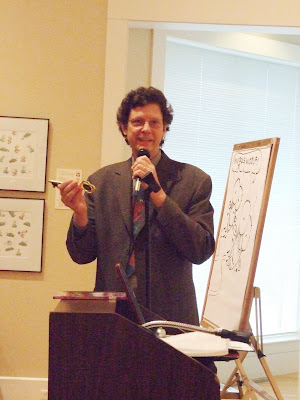 Tedd now holds the key to the city!

 As television crews record the event, Tedd Arnold draws "on the fly," as Rick Pirozzolo introduces the Mayor of Elmira, the honorable John S. Tonello.
 One of Tedd's colorful characters looms behind Rick, who seems oblivioius to the mischief as he addresses the crowd.
Fairy Tales will be up through April 23th and Tedd Arnold: Reading Pictures will be on display until May 22. Admission to the Arnot Art Museum is free.
Thursday, December 3, 2009
EFA art students involved in entrepreneurial project
Art students in June Gordon’s Photography class designed a set of notecards that are now on sale to the public. The fold-over notecards have 12 unique images, some black and white and some in color, that are printed on high-grade paper. The cards are blank inside and come with matching envelopes. A set of 12 is on sale for $6.
Profits will be used to help fund a student trip to visit art museums in New York City. Notecards may be purchased at the EFA main office, or by emailing jgordon@elmiracityschools.com.
 Family Feet by Molly Hitchcock, Junior at EFA
Profits will be used to help fund a student trip to visit art museums in New York City. Notecards may be purchased at the EFA main office, or by emailing jgordon@elmiracityschools.com.
SEE TWO SAMPLE NOTECARD IMAGES BELOW:
 Family Feet by Molly Hitchcock, Junior at EFA

Tuesday, October 27, 2009
Watch Rhonda Morton, "Alligator Mouth Five" artist on "Move It!"
Rhonda Morton, founder of "Alligator Mouth Five," and GST BOCES artist, recently appeared on the "premiere episode" of Move It! She worked with the cast on improvization. She demonstrated her flair for improvization by making up a song about food "on the spot!" As Rhonda explains, when she is working with her group, Alligator Mouth Five, "everything is created in the moment."

http://www.youtube.com/watch?v=iP5K2cZfelA
Rhonda wants students to know that they "always have more choices than they think they do...they are always the author of their own lives....and get to wite their own story every moment of the day." She worked with Linda Doty and Cohen Elementary students and teachers last year through GST BOCES Arts in Education. Check it out!
Alligator Mouth Improv at Cohen Elementary School
Wednesday, June 3, 2009
Watkins Glen Arts in Education web-page
Watkins Glen has a very rich Arts in Education program. They have been featured on the GST BOCES Arts in Education web-page a couple times.
http://www.gstboces.org/iss/artsineducation/Watkins%20an_innovative_arts_integration_p1.htm
To see more, Marianne Morin suggests you go to their own web-page where you can see many hundreds of clips including their artists and students' work. The most recent work is at the bottom of the menu.
www.lightlink.com/wges
http://www.gstboces.org/iss/artsineducation/Watkins%20an_innovative_arts_integration_p1.htm
To see more, Marianne Morin suggests you go to their own web-page where you can see many hundreds of clips including their artists and students' work. The most recent work is at the bottom of the menu.
www.lightlink.com/wges
Campbell Savona Musical receives 6 awards!

Tom Freeland of Campbell Savona School District informs us that the Campbell-Savona School musical from last November - Singin' In The Rain - was honored with six awards last Thursday at the Rochester Broadway Theater League's Stars of Tomorrow yearly ceremony, including:
Outstanding Production Crew
Outstanding Singing Ensemble
Outstanding Acting Ensemble
Outstanding Lead Actress - Olivia Tyler (as Kathy Seldon)
Outstanding Lead Actor - Jared Allen (as Don Lockwood)
Outstanding Musical

Thanks to their respective wins, Olivia and Jared are moving on to phase 2 and will be competing June 7th against the other division winners for a chance to participate in the National High School Musical awards in NYC - June 25-29. Tom wishes to thank everyone that was involved in making the production a huge success!
See the GST BOCES Arts in Education web-page to learn of other events that have taken place at Campbell Savona!
http://www.gstboces.org/iss/artsineducation/Campbell%20Savona%20page.htm
Outstanding Production Crew
Outstanding Singing Ensemble
Outstanding Acting Ensemble
Outstanding Lead Actress - Olivia Tyler (as Kathy Seldon)
Outstanding Lead Actor - Jared Allen (as Don Lockwood)
Outstanding Musical
Thanks to their respective wins, Olivia and Jared are moving on to phase 2 and will be competing June 7th against the other division winners for a chance to participate in the National High School Musical awards in NYC - June 25-29. Tom wishes to thank everyone that was involved in making the production a huge success!
See the GST BOCES Arts in Education web-page to learn of other events that have taken place at Campbell Savona!
http://www.gstboces.org/iss/artsineducation/Campbell%20Savona%20page.htm
Wednesday, May 27, 2009
Arkport Superintendent, William Locke, receives ARTS Partnership Award!

William Locke, the Superintendent of the Arkport Central School District and Fine Arts Liaison for the GST BOCES Superintendent's Advisory Council was honored as the recipient of an ARTS Partnership Award through The ARTS of the Southern Finger Lakes at the International Motor Racing Research Center in Watkins Glen, NY, on May 21st.
As stated in a Press Release from ARTS of the Southern Finger Lakes:
The ARTS Council of the Southern Finger Lakes is proud to recognize this year's recipients of The ARTS' Annual ARTS Partnership Awards, which recognize individuals, artists, volunteers, schools, organizations and businesses that significantly contribute to the region's arts and cultural life.
"This year's ARTS Partnership Award recipients are forces of nature in the region's arts and culture scene," said Ginnie Lupi, The ARTS' director, "their passion is inspirational and we're indebted to them for all they do." This year's recipients are:
William Locke, Superintendent, Arkport Central School District, for creating stellar arts programming for the schools in his district and for being an invincible advocate for the arts in the Arkport/Hornell region in Steuben County. Locke is an actor and vocalist who has performed in many plays and musical events. He was instrumental in the creation of the Hornell Rotary Club Summer Musical Program and serves as an adjudicator for the Rochester Broadway Theatre League.
"Mr. Locke's passion for the arts and education inspires many students to participate in the arts either as perceivers or makers - performers, musicians and visual artists."
Lynne Rusinko, Arts Advocate, of Elmira, NY, also received an award for her tireless commitment, outstanding contribution and dedication to artists and organizations in her community. Ms. Rusinko's enthusiasm, creativity, passion and skills have helped the arts thrive throughout the region. She has volunteered countless hours to the Elmira Open Studio Tour, Steele Memorial Library's Poetry Festival, Community Arts of Elmira, Festival of Women in the Arts, and the Elmira Street Painting Festival.
 "Lynne does all of this volunteer work - graciously and quietly - behind the scenes. Lynne Rusinko is a friend to the arts and works for the greater good of all the groups with which she is involved - ensuring the success of each project." - - Kathleen Huddle, Nominator
The ARTS Council of the Southern Finger Lakes presented this year's awards at its Annual Meeting on Thursday, May 21, at 5:30 pm at the International Motor Racing Research Center,
The ARTS Council of the Southern Finger Lakes is the leading arts services and development agency in Chemung, Schuyler and Steuben counties.
To see more pictures from the ceremony and read more about the event, go to the GST BOCES Arts in Education web-page at:
The Education staff at the Rockwell Museum talk about Arts in Education

Thanks to the dynamic and dedicated staff at the Rockwell Museum of Western Art, there is always something new and exciting happening at the museum for students in the GST BOCES region to discover! The three women in the photograph above - Education Coordinator, Lori Rajsky; Director of Education, Gigi Alvare; School and Docent Program Manager, Mary Mix - all work in the education department and have a special mission to provide young visitors of the GST BOCES region and beyond with an educational experience they will not be able to forget. They accomplish this through schools tours and special programs which reach out and attract students and their teachers and families from pre-K through high school. Each experience is standards-based arts in education in action through which students develop visual literacy, critical thinking and communication skills during the tours. Curriculum connections are made with writing, listening, speaking, patterns, geometry, math by counting and exploring comparative terms, symbols and mathematical sequencing, light and shadow, animal families, communities, families, career options, history of the Native Americans, U.S. History, Geography.
In the video below, Mary, Gigi and Lori speak about the instrinsic benefits of Arts in Education and how the Rockwell Museum can help students meet NY State mandated standards.
To read more about these tours and the exciting experiences awaiting people of all ages at the museum, check out the GST BOCES web-page http://www.gstboces.org/iss/artsineducation/rockwell2009.htm.
Wednesday, April 29, 2009
Hua Hua Zhang at Parley Coburn School!
Hua Hua Zhang visited Parley Coburn School for a week-long residency the week of March 16th. During the week, third grade students studied the art of making shadow masks and Chinese dragons. Each day Hua Hua taught them a word of Chinese, including " Hello" "Thank you" "You are welcome" "Good bye" and "Dragon." Students also completed four projects: 1. Draw a Chinese Dragon. 2 chinese Calligraphy. 3 Shadow puppet. 4 chinese dragon dance.
 Hua Hua Zhang
 Hua Hua and students do the Chinese dragon dance
 An example of a student's drawing of a dragon
The word "Love" in Chinese calligraphy

"Dragon"

"Harmony"
Wednesday, December 3, 2008
Aleta Wynn Yarrow in GST BOCES schools
Aleta Wynn Yarrow is a visual artist who has worked in the GST BOCES region for many years. She is currently the featured visual artist on the GST BOCES Arts in Education web-site. Read about the murals she helped to facilitate at Center Street School as well as the philosophy behind the work she does in many other regional schools. See Aleta Wynn Yarrow .
To see more examples of the visionary work she creates, see her own web-page at http://www.aletayarrow.com/. To learn more about her philosophy of education, see http://www.ordinarygenius.info/.

 Patience by Aleta Wynn Yarrow
To see more examples of the visionary work she creates, see her own web-page at http://www.aletayarrow.com/. To learn more about her philosophy of education, see http://www.ordinarygenius.info/.
 Patience by Aleta Wynn Yarrow
Tuesday, December 2, 2008
Alligator Mouth Improv at Cohen Elementary School

Alligator Mouth Improv members, Rhonda Morton and Amber Espar visited Cohen Elementary School in the Elmira Heights School District for a full day of workshops with students. They worked closely with the other teachers, especially Linda Doty, Pre-K teacher at Cohen who organized the Arts in Education programming this year. Check out the GST BOCES Arts in Education web-page to read more at
Also check out the Alligator Mouth Improv web-page at http://www.rhondamorton.com/alligator.html

Linda Doty is shown here on the right with 3rd grade teacher, Linda Darrow.
Wednesday, November 5, 2008
The very first GST BOCES Arts in Education Parent in the News - Irene Peterson!
 The GST BOCES Arts in Education web-page http://www.gstboces.org/iss/artsineducation/ features artists, staff and students instrumental in bringing quality arts in education programming to your students. We are now pleased to introduce our very first Arts in Education Parent in the News, Irene Peterson. Irene is the very articulate mother of two sons, both of whom are students at Center Street Elementary School in the Horseheads Central School District. In addition to being a parent, Irene works as a materials engineer at Corning Inc. Irene is very pleased that her children attend Center Street School. She reports that the school "helps to instill curiosity, perseverance, collaboration and respect for knowledge in her children."
For Irene, the arts in education are integral in helping to achieve the quality of education Irene and her family enjoy at Center Street.
Art education is important to you and your children because it allows them to create beauty, to learn about other cultures, to learn that perseverance brings improvement and to appreciate and to enjoy the talents of others. It also exposes them to other cultures. Activities such as the orchestra and band teach them how to lend their talents to projects larger than themselves. The arts make the world a better place because they build friendships, develop an appreciation of talents of others, break stereotypes, helps students learn about and appreciate other cultures, learn new ways of viewing the world and of expressing themselves.
Given Irene's career path as an engineer, it may seem surprising to learn that Irene's favorite subjects were art and music. "Some girls get intimidated by Math, but not by their ballet lessons; however, it's all about recognizing a pattern. Sometimes if you can draw a connection to something familiar, it breaks the fear."
Irene especially loves music and to sing. To read more about Irene and her school, go to
Irene Peterson.
Subscribe to:
Posts (Atom)